 |
Eight oral presentations and six posters demonstrate advances in mammography, DBT performance, and density-informed risk modeling
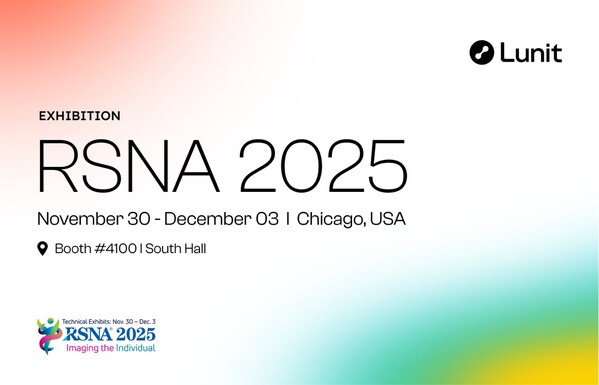
SEOUL, South Korea, Dec. 2, 2025 /PRNewswire/ -- Lunit, a leading provider of AI for cancer diagnostics and precision oncology, today announced it will present 14 studies at the Radiological Society of North America (RSNA) 2025 Annual Meeting. Spanning screening mammography, digital breast tomosynthesis (DBT), breast density science, and risk modeling, this year's program represents one of the company's most extensive evidence portfolios to date. Lunit will exhibit at South Hall, Booth #4100, and host expert-led sessions in the Lunit Education Room #1252 throughout the meeting.
Among the highlighted research, real-world results from Capio S:t Göran Hospital in Sweden evaluated more than 193,000 screening examinations before and after the introduction of Lunit INSIGHT MMG. When AI was paired with a single radiologist, the screening program achieved higher invasive cancer detection, greater positive predictive value, and fewer unnecessary recalls compared to human-only double reading—reinforcing findings from the ScreenTrustCAD interventional trial and demonstrating that AI-integrated single reading can maintain or improve accuracy while alleviating workforce pressure.
New evidence from Massachusetts General Hospital assessed AI performance on screening DBT using 1,000 retrospective examinations, showing that Lunit INSIGHT DBT correctly localized 84.4% of true-positive cancers, with particularly strong performance for mass-presenting and invasive ductal carcinoma cases. The study also detailed cancer subtypes less likely to be identified by AI, offering practical insight into the algorithm's strengths and limitations as DBT adoption accelerates worldwide.
Further expanding the evidence base, two oral presentations from Elizabeth Wende Breast Care explored how volumetric breast density, as quantified by AI-powered algorithms, and family history influence risk stratification across leading models, and how density changes over time affect prediction consistency. In a cohort of 44,651 women, Tyrer-Cuzick classified substantially more women as high-risk than BOADICEA, driven by heavier weighting of density and family history inputs. A complementary longitudinal analysis of 335,000+ images demonstrated that incorporating volumetric breast density over time improved calibration and discrimination, while static or categorical density inputs consistently underestimated cancer incidence. Together, these findings strengthen the role of density-informed and longitudinal risk modeling in supporting risk-adapted screening strategies.
Lunit will also host a series of expert-led sessions in its Education Room #1252, offering deeper clinical and scientific perspectives on key themes presented at RSNA. Highlights include:
"RSNA is where the field looks to understand whether AI is delivering measurable clinical value, and this year's program reflects that momentum," said Brandon Suh, CEO of Lunit. "Across mammography, DBT, and density-driven risk modeling, our studies highlight how rigorously validated AI can enhance screening performance, support radiologists, and strengthen the foundation for risk-adapted care. We remain committed to generating evidence that drives responsible and meaningful adoption in clinical practice."
###
About Lunit
Founded in 2013, Lunit (KRX: 328130) is a global leader on a mission to conquer cancer through AI. Our clinically validated solutions span medical imaging, breast health, and biomarker analysis—empowering earlier detection, smarter treatment decisions, and more precise outcomes across the cancer care continuum.
Lunit offers a comprehensive suite spanning risk prediction and early detection to precision oncology. Our FDA-cleared Lunit INSIGHT suite and breast health solutions support cancer screening in thousands of medical institutions worldwide, while the Lunit SCOPE platform is used in research partnership with global pharma and laboratory leaders for biomarker research, and companion diagnostic development.
Trusted by over 10,000 sites in more than 65 countries, Lunit combines deep medical expertise with continuously evolving datasets to deliver measurable impact—for patients, clinicians, and researchers alike. Headquartered in Seoul with global offices, Lunit is driving the worldwide fight against cancer. Learn more at lunit.io/en.
Appendix - Lunit RSNA 2025 Full Study List
Oral Presentations (8)
Poster Presentations (6)